
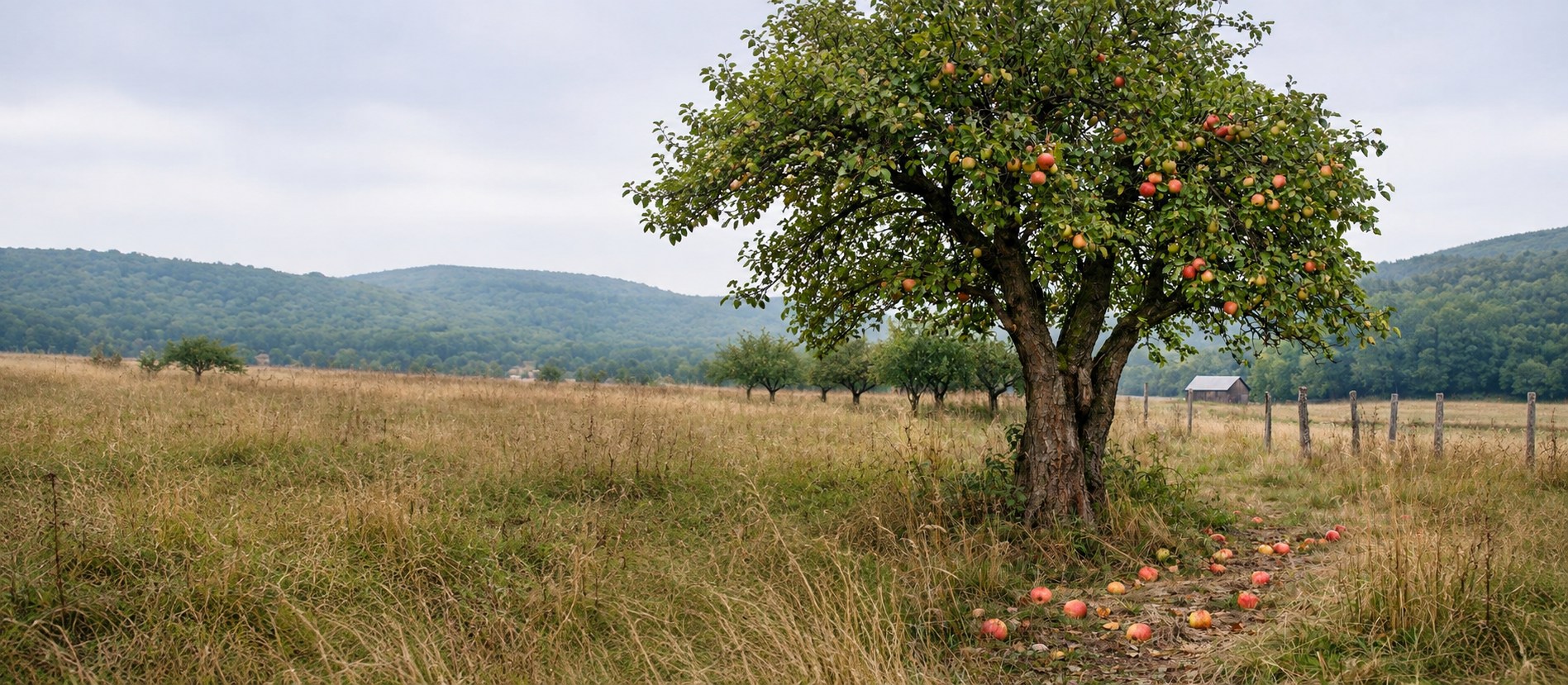
An ancient tree
A broad, weathered trunk; hollow limbs; a tree that seems older than everything around it.

THE HERITAGE APPLE PROJECT · NEW YORK
The tree behind a stone wall. The one beside an old barn. The apple your grandparents called by a name no one else remembers. Help us find the trees—and the stories—that time nearly left behind.
A FLAVOR CAN BE A TIME MACHINE
You picked it warm from the sun. Maybe it was striped, knobby, impossibly crisp, or sweet enough to stop you in your tracks. Juice ran down your wrist. For one perfect minute, the whole world was an old tree, tall grass, and the apple in your hand.
Across New York, trees like that still survive in forgotten orchard rows, along field edges, beside cellar holes, and in the yards of families who have quietly cared for them for generations. Some may be rare named varieties. Others may be seedlings found nowhere else on earth.
When one disappears, we can lose more than fruit. We can lose a family memory, a piece of local history, and a unique living inheritance.
WHAT MIGHT BE WAITING NEAR YOU?
Old apples often persist where no one thinks to look. You do not need to know the variety. You only need curiosity—and a reason to wonder.
A broad, weathered trunk; hollow limbs; a tree that seems older than everything around it.
Odd shape, unexpected color, remarkable flavor, late ripening, long keeping, or an apple unlike modern store fruit.
A family name, local nickname, old recipe, cider tradition, or story about where the tree came from.
An old farmstead, abandoned orchard, stone wall, cellar hole, hedgerow, or barnyard edge.
Please explore respectfully. Never enter private land, pick fruit, or take cuttings without the owner's permission. A roadside glimpse or remembered story is enough to begin.
FROM MEMORY TO LIVING COLLECTION
The work is slow by design. Every step protects the tree, the landowner, the story, and the identity of the material we preserve.
Historic records, family memories, and community reports point us toward promising trees.
With the owner's invitation, we collect the tree's history before we collect anything from the tree.
Near ripening, we photograph, measure, taste, and record the tree, its apples, its health, and its location.
With separate written permission, dormant scions may be collected carefully for propagation and laboratory work.
We work to establish traceable living material, investigate identity, return findings, and keep the story connected to the tree.
Tissue culture, traditional propagation, historical comparison, and sometimes genetic testing can all contribute. Establishment may fail, testing can be inconclusive, and growing a new tree can take years. We will be honest about what is known, what is uncertain, and what still needs to be learned.
THE PEOPLE ARE PART OF THE PRESERVATION
Tell us what the apples were good for. Fresh eating? Pies? Sauce? Cider? Did they keep in the cellar until winter? Did children climb the branches? Was there a family recipe, a local name, or someone who always knew exactly when to pick them?
Those details may never appear in a book or database. They live with people—and they are as important to this project as measurements, photographs, or laboratory results.
Share what you rememberJOIN THE HUNT
We are beginning in Rensselaer County and welcome promising leads from anywhere in New York. A complete history is wonderful, but it is not required. Tell us what caught your attention and what you know so far.

There are apples still growing whose names have been forgotten.Report a heritage apple tree
Let’s find them before the trees are gone.